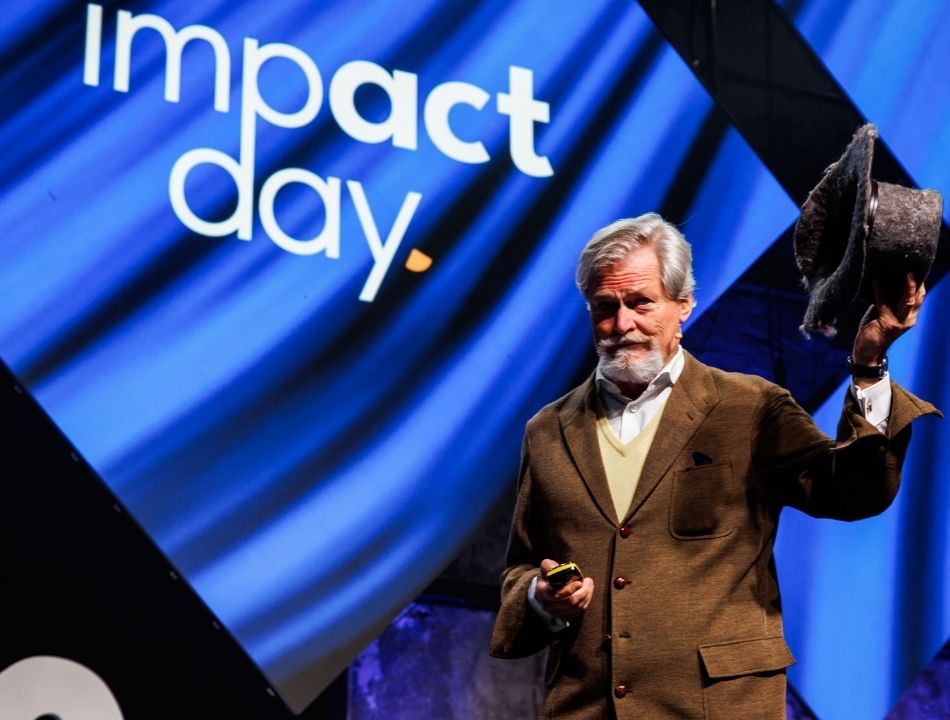
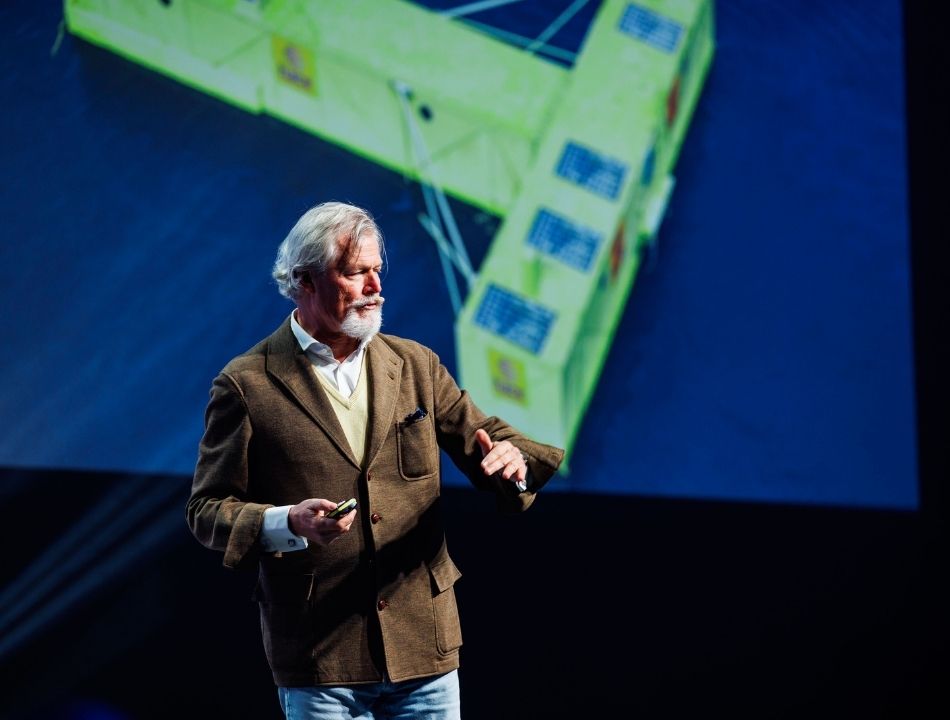
Gunter Pauli on stage at Impact Day 2025 – photo credit: Rasmus Kooskora
Visionary, speaker, entrepreneur, creator, futurist, and celebrated author of the ground-breaking book ‘The Blue Economy’, Gunter Pauli has been doing far more than wowing audiences – he’s been rewriting perspectives…for decades.
Having been present at several events of his in the past, I was very much looking forward to his keynote address at Impact Day 2025 on Friday, October 10, here in Tallinn, Estonia.
The last time I’d seen him, a few years back, also here in Estonia, he’d showcased how he and his team were revolutionising self-sufficiency and energy sustainability in schools in South America, describing new ways to harness nature in sustainable, harmless, and highly productive ways.
I was excited to hear what he’d been up to since, and I was far from disappointed!
As a speaker, Gunter has all the qualities you’d expect: presence, charisma, style, and panache in abundance. He can hold an entire room with a single word. A pause in his flow is much-needed space for our minds to catch up with the sheer weight of whatever-he’d-just-said.
And then he pushes us deeper into his thoughtsphere, introducing us to heavy concepts with such a light touch that they land effortlessly.
One is often left thinking, “But that’s so obvious – why aren’t we doing it?!”
In this presentation, he succeeded in blowing minds yet again by discussing, among other things, running the internet through the oceans using AM radio waves. Wait a second, what with how and who now?!
At first, it sounds confounding, almost logic-defying, yet when he explains things that would ordinarily melt my synapses, they make perfect sense…
So, if you weren’t in the room or haven’t heard or read yet about Gunter’s visionary approach to creating sustainable and regenerative systems, utilising resources our oceans already provide, here are some highlights of what I understood from his keynote speech.
Towards the Ocean Economy
For the uninitiated, Gunter Pauli’s “The Blue Economy” theorises on (and offers practical solutions for) establishing sustainable business practices that draw inspiration directly from natural ecosystems.
He proposes a shift away from the “take, make, dispose” system and instead to a regenerative, symbiotic one. The Blue Economy seeks to harness abundance from locally available resources in innovative ways that are both economically viable and environmentally sustainable.
With an ‘Ocean Economy’, Gunter is proposing that we learn much, much more about oceanic ecosystems than we have learned thus far (which, he believes, is nowhere near enough). Then we can prosper from them in more sustainable ways than the exploitative ones we’ve adopted.
Nature, he says, has much to teach us, if only we’d be more open to learning.
“We need to generate value, which includes the impact such value can have. When we analyse what we have at our disposal, we can see its true value. We have to share our ideas – with depth.” (Literally, in this case – read on!)
He bemoans the status quo of economic systems that rely on outmoded thinking and, as Seth Godin has also observed, wonders why we persist in educational models that add nothing progressive.
“We’re still training a million MBAs a year who use Excel spreadsheets to measure profit. That’s the impact they’re looking for. It’s partly why you’re having this meeting (Impact Day) here; we have to adopt a completely different mindset and focus on the opportunities we have. In Europe, we’ve lost that mindset, and we need to recover it again.”
If we are to achieve Impact Day’s stated aim of a “bold, self-sufficient Europe”, then Gunter is absolutely right.
We need to rediscover a mindset that sees and reaches way beyond spreadsheets and profit ledgers…one which dares to embrace bold ideas that generate the very self-sufficient, affordable, sustainable, and secure energy supplies we so desperately need.
Two Types of Waves
Looking ahead then, Gunter sees that, “The big future is in our waters. In all the space where there is life on Earth, 91% of it is underwater – and we know nothing about it. The Blue Economy needs a culture of the ocean. We want to lift people out of water poverty, but we think it’s not possible.”
Fear, he conjectures, is the major obstacle to this necessary shift. And fear, as we all know, stifles, distorts, and suppresses open communication. That topic in itself was the focus of his first key message regarding the ‘Ocean Economy’ – the realisation that oceans hold the key to improved global communication.
“Currently,” he points out, “the only way to communicate via water is to throw a bottle into the sea with a message inside. There’s no other way! However, the biggest growth we’ll ever see will be Ocean Communications, which will be ten times bigger than any other form we have now.”
“What does he mean here with ‘Ocean Communications’?”, we wondered. “Where’s he going with this?” Well, it turns out he’s proposing that ocean-based communication, using radio waves, will revolutionise global communication.
The premise is that AM radio waves are a far, far more efficient way of sending data than our current method of bouncing signals off the myriad of satellites out in space.
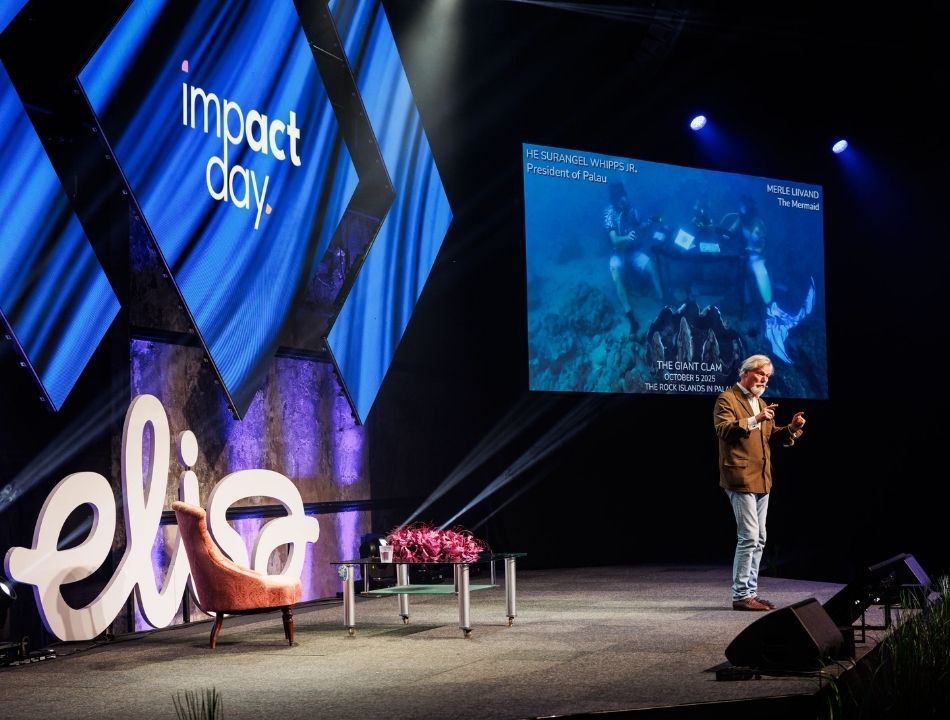
Gunter Pauli on stage at Impact Day 2025 – photo credit: Rasmus Kooskor
“Compare satellite-based communication with AM radio waves, and you can see the potential shift from high cost to free use of ‘internet oceans’. The key advantage of AM waves is that they are 2-way. A very simple algorithm can carry video, image, voice, and data transmission. We’re not using radio waves like with WiFi or 5G; we’re using AM radio waves – because they’re free – and we’re already achieving 250 Mbps through the water.”
And here comes the surprise we were promised…
Gunter illustrated the feasibility of this idea by declaring he had the cooperation of an entire nation’s government to shut down a whole nation’s internet for 15 minutes – “and you need a very cooperative nation to do that!” (Ed: regrettably, we cannot reveal which nation it was, but I was surprised!)
His team ran that nation’s full internet connection service solely with the use of AM radio waves to prove that this method, “and not 60,000 satellites in orbit”, is the future.
“We need to go back to basics.” he emphasised, pointing out that, “We consumed 1/10 of the energy for the same transmission by not using satellites. Are we not aware of the excessive energy consumption across the internet? Radio will make a huge difference.”
In Gunter’s inimitably frank way, he closed this topic with an emphatic, “Wake up! Change the tech! Get to the goal: full 3D internet!”
And this is what I meant earlier about pushing an already mind-blowing idea deeper…
The 3D Web
Gunter’s ambition is for us to experience a significantly improved version of the internet, one whose protocols are currently limited in their representation of information and experiential capability. The current web is what Gunter describes are merely “two-dimensional.”
His main gripe with the current web is that it’s based on protocols that put everything into 2D. That means we have a 2D web. It’s flat. You can’t see around or through it. As an educational tool, it’s mere words and pages – an electronic library in which you can’t even pick up the books.
The absence of a third dimension potentially seriously restricts cerebral development, a crucial need for the human race if we’re to navigate our way out of an unsustainable approach to living! Nature exists in more than two dimensions. Gunter wants our Web to do the same.
Instead of the stagnant status quo, he foresees the application of a three-dimensional approach, one that he also refers to more extensively in his book, “The Third Dimension,” based on the idea of working with nature, rather than always fighting against it, a theme he refers to often, e.g., “The only way to exist is to be inspired by nature – it knows how to deal with crises.”
Imagine a truly 3D web, with truly 3D interactive screens – no goggles, no headsets, just exactly as you see in sci-fi films set decades in the future. “Ask video gamers and doctors which version they’d prefer!”
Imagine also an education system that not just taps into our innate ability to engage with our surroundings in the way we’re meant to – it can become an active agent in our growth, encouraging and stimulating creativity and human development.
That technology, he points out, is already here – so why isn’t it being widely adopted? Perhaps a clue to the answer lies here:
“When we make the shift to 3D, our friends from Amazon, Meta, and others will lose all their protocols. The new thing, therefore, is the spatial web. All AI protocols will be invalidated when 3D arrives with 1,000 times more code. And we’re ready today! In a couple of months, the leading 3D company will launch on Nasdaq…it’s coming.”
That said, with innovation, there’s always something of a ‘rebound effect’. Initially at least, “we’ll need to consume more energy to make this work.”
Therefore, he asserts that we’ll need “baseload renewables that work 24/7, 365. A few windmills and floating solar panels equate to 1960s tech! We need to shift.”
And here he’s bang-on. There’s much in our world that we think of as “innovative”, yet relies on principles which have not moved on sufficiently in order for any desired reality to materialise.
There are concepts he’s working with, both theoretical and practical, that outdate already-applied technology – and his message has consistently been for us to accelerate their application.
Swell & Swirl
The idea of using our oceans to generate power isn’t new – it’s been around for a while – yet for some utterly unfathomable reason, we’re not making the most of it.
Maybe it’s been considered too science-fictiony for some, unscalable for others, or (most likely) the bean counters haven’t found a way to fit the idea into their limited and restrictive profit-driven economic models…
Perhaps what’s really missing is the compelling evidence of its efficacy? If that’s the case, then more people should be listening to Gunter because the evidence is coming to us – in waves – literally.
“Baseload” is a term Gunter uses as an example of where we’re failing in sustainable energy supplies. As mentioned, one of his constant messages is that we don’t learn enough from nature.
And while baseload is seen as a minimum amount of energy required to keep an electricity supply grid operational, the more reliable sources of it we have, the less we need to depend on less sustainable methods of meeting demand.
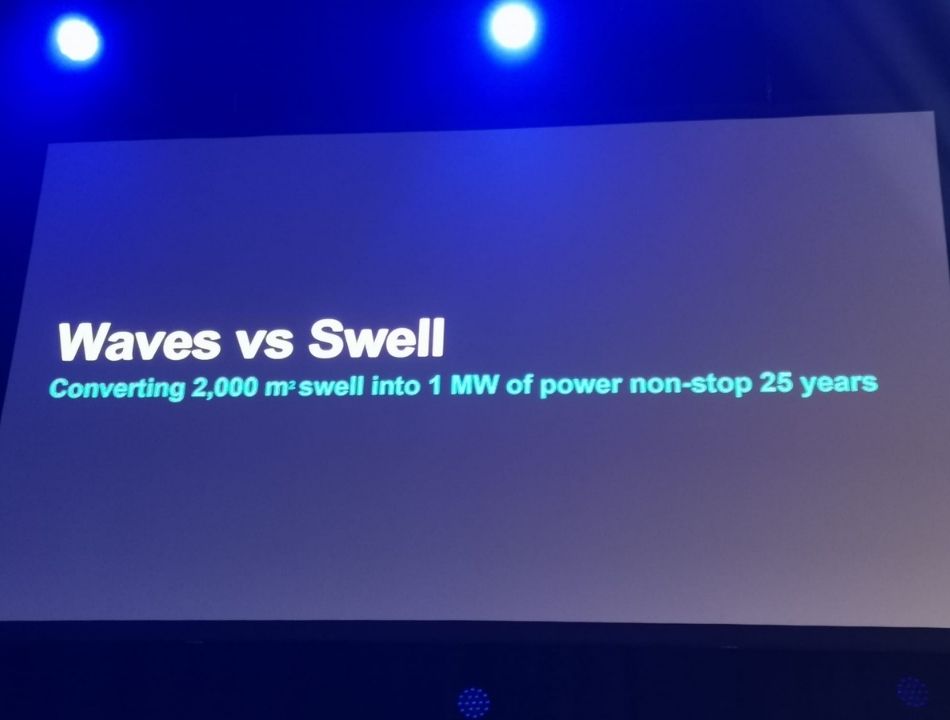
He explains that, “Baseload forces in nature, which always work, are waves; and ‘swell’ is the continuous expansion and contraction of water as a result of the Earth’s spin. It continues forever.”
Tapping into this effectively limitless (until the world stops spinning or our sun goes supernova!) resource should provide us with a far greater amount of baseload need than we’re currently getting. Some argue that the technology just isn’t there or isn’t reliable enough or isn’t truly sustainable.
To address these objections or dismissals, Gunter revealed, “We’re fast-tracking thousands of installations, converting 2,000 m2 of swell into 1MW of power non-stop for 25 years.”
His platforms utilise piston mechanics as the driver, one of humankind’s oldest known methods of generating momentum. He further asserts that the units are practically indestructible as well.
And here’s the punchline: they can produce that 1MW of power 24 hours a day, 365 days a year, at a cost of just 2 cents per kWh. “Say goodbye to many of the other technologies!” he quipped.
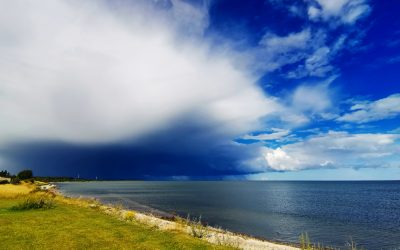
Waves vs Swell – photo credit: Jim Sharman
Fly a Kite!
Moving on from swell to swirl, then, Gunter introduced us to how he’s using kite technology to capture energy generation at hundreds of meters above the ground. A kite sail ascends and descends continuously to a height where the wind is more ‘reliable’ and plentiful than at ground level.
One of the principal benefits of such technology includes redesigning how a remote resort in a tropical climate can supply itself with sustainable power.
Experimental facilities already exist on the Hawaiian islands, where wind and topography are being analysed to determine where such kites can be installed to maximise the potential generation. They’re already demonstrating much greater energy production capability than any equivalent wind turbines, which fail to capture the same effect.
He goes further than that, too, in order to demonstrate the power of analysing and then reusing what we already have.
With is usual enthusiasm, he revealed, “We’re repurposing old oil platforms that are considered ‘too expensive’ to decommission and we’re converting them into hydrogen-producing kite sites. We’re seeing thousands of convertible-ready platforms in Brazil and Malaysia.”
This begs the question of where else in the world we could make this happen…
Gunter Pauli on stage at Impact Day 2025 – photo credit: Rasmus Kooskora
Another example – will Ocean Thermal Energy Conversion finally turn large-scale commercial? Currently, he pointed out, there’s a simple deep-water heat exchange system cooling an entire airport in Hawaii.
And with this point, he reminds us of our need to learn from nature, not steal from or fight it. “The ocean is the most stable heat delta you could have! And the beauty of using water from 400m depth is that there are no bacteria we’d otherwise have to deal with.”
The future, then, is already here. Yet, too many countries are lagging in adopting systems that already work, a source of frustration I’ve heard him express before. He reiterated this frustration today, saying, “Bypass proof of concept, because the impact is needed now ! Not in 25 years. Europe is not fast enough; it prefers to discuss ‘other things’.”
My interpretation of these ‘other things’ is the apparent obsession with over-regulation he has previously suggested the EU is addicted to.
Impact Day has been calling for the deregulation of excessive red tape since its inception, a challenge that is a rallying cry for many who understand the urgency of the need to adapt.
It’s clear to all with eyes and ears that regulation has its place, yet it’s equally clear that over-regulation is holding us back in too many ways.
Maybe too many parties with vested interests in not applying these solutions continue to hold too much influence?
A Better Way?
Do you see what I mean about being far from disappointed? Pure inspiration. In just 40 minutes.
Now, I’m not a scientist (five years as a meteorologist, 30 years ago, surely doesn’t count here!), so I can’t exactly peer-review what Gunter Pauli spoke with us about…
That said, what is undeniable is the frisson of excitement when you hear what’s not only possible, but what’s already been done on the back of his determination to implement what he knows is possible.
And when you hear it, you cannot unhear it – the key message in everything I’ve ever heard him say – which essentially boils down to there being a better way that doesn’t involve so much inefficiency and waste.
There is indeed a better way.
Something as simple as a kite, a piston, a sea-floor-based cooling system… and when you mentally scale that idea up, you’re left sitting in your seat wondering, “Why aren’t we scaling up?!”
That’s a question for our nations’ leaders – why not? It’s also a question for anyone who prioritises profits over the betterment and development of humanity. Why not, when there’s a better way that embraces sustainability over exploitation?
And you, dear reader, can ask yourself this question: who is getting in your way to achieve a future you know benefits us all? When we identify who, we can start to understand why – and then we can plan how to get past those hurdles. We have that power…
As ever, it was a privilege to watch and hear Gunter introduce ideas to an audience keen to understand how we can make progress as a race without compromising our environment.
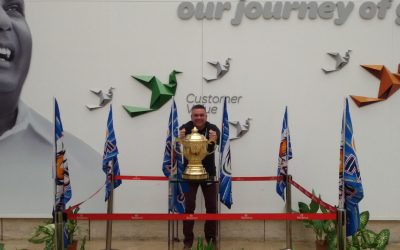
Gunter Pauli & me – photo credit: Jim Sharman
Impact Day is a community of like-minded people who seek to inspire and be inspired in turn. The invitation is always there to join in – at any time – you don’t need to wait for the event to start making a real difference. Act for impact today.